
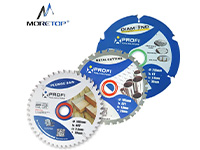
Moretop vs Generic Suppliers: What Global Tool Buyers Should Really Compare
13 years / over 10 years of OEM & ODM experienceComparison guide for global tool buyers Global buyers often compare Moretop with generic suppliers as if the decision were mostly about FOB price. In cutting and drilling accessories, the real comparison is broader: category depth, application knowledge, OEM support, documentation discipline, and how reliably the supplier helps the distributor sell and replenish the range after the first order ships. This guide shows what importers, distributors, and private-label buyers should compare before choosing between a category-focused partner such as Moretop and a generalist supplier with a broad but shallow catalog. A generic supplier is not necessarily a bad supplier. In many cases, it is a company that sells many product categories, quotes quickly, and can source a wide mix of items through different factories. The limitation appears when the buyer needs product advice instead of simple fulfillment. In saw blades, drill bits, and related accessories, weak category depth usually shows up in vague performance claims, inconsistent assortment logic, and slow answers when the buyer asks material-specific questions. That is why global tool buyers should compare business fit rather than labels. The right question is not whether a supplier calls itself a factory, trader, or specialist. The right question is whether it can help you build a repeatable, market-ready accessory program with fewer claims and fewer commercial surprises. A cheaper opening quote can become an expensive supply decision once claim handling, repacking, sample rework, freight timing, and reorder delays are included. Buyers that compare only unit price often discover too late that the supplier cannot stabilize blade quality, keep labels consistent, or answer technical complaints quickly enough for distributor channels. For distributor buyers, total operating value usually matters more than first-order price. That includes lead-time discipline, technical answers, packaging control, and commercial follow-through. Generic suppliers often win attention with a long spreadsheet of items. Category-focused partners win long-term business by helping the buyer select the right SKUs for real applications. In cutting and drilling accessories, that means understanding material mix, machine type, tooth geometry, coating choices, kerf expectations, and the price ladder needed in the target market. Moretop’s current site positioning is strongest when evaluated on this dimension. The company presents itself as a cutting and drilling specialist with breadth across saw blades, diamond tools, hole saws, drill bits, abrasives, and specialty accessories rather than a loose general-hardware catalog. Buyers should expect suppliers to explain why one blade fits framing timber, why another suits rebar or thin sheet metal, and where a multi-material blade saves channel complexity. That level of application knowledge becomes more important when dealer staff or end users ask questions about material suitability, RPM limits, finish quality, and expected service life. U.S. OSHA guidance for portable circular saws still emphasizes correct guarding and proper blade use, which is a reminder that supplier documentation and application guidance are not minor extras. A serious partner should be able to match the blade to the job and explain the use conditions clearly before bulk production begins. ISO describes ISO 9001 as the world’s most widely used quality management standard, with more than one million certificates issued in 189 countries. For buyers, that does not mean a certificate alone proves performance. It means serious suppliers should already think in terms of documented processes, corrective actions, and repeatable controls rather than informal promises. In practical terms, global buyers should compare how each supplier handles incoming materials, blade inspection points, non-conforming stock, and complaint feedback loops. The key issue is whether quality control exists as a repeatable system or only as a sales claim made before the order is placed. Many generic suppliers can print a logo. Fewer can support a distributor launch properly. Private-label success depends on range logic, packaging hierarchy, claim wording, carton consistency, barcode placement, image support, and a clean approval process between sampling and mass production. Moretop’s current site gives the company a stronger position here because it highlights custom package design, logo creation, market analysis support, and broader marketing assistance. For distributors, that matters because good packaging and range presentation reduce sell-through friction in both retail and e-commerce channels. Tool buyers should compare launch practicality, not just quoted unit economics. A supplier that insists on large opening volumes can trap a buyer in slow-moving inventory. A better partner helps the buyer stage the opening range, validate the top sellers, and expand only after reorder data is visible. On Moretop’s current site, the company highlights a 24-hour response target and regular mass-production lead times of roughly 50 to 60 days (non-peak season). Those are useful indicators, but buyers should still compare exact lead times by SKU family, mixed-order rules, and the speed of replacement shipments when something must be corrected. Since the EU General Product Safety Regulation framework took effect in December 2024, distributors selling into the EU have stronger reasons to compare documentation discipline early. EUR-Lex summaries and the regulation text make clear that distributors must verify key manufacturer and importer obligations and be able to support traceability and corrective action when products are questioned. That does not turn every sourcing discussion into a legal review. It does mean that a supplier with weak documentation, poor labeling control, or unclear safety information creates downstream risk for the buyer. Generic suppliers often treat this as paperwork. Stronger partners treat it as part of normal commercialization. Fast replies are useful, but generic replies are not. Buyers should compare whether the supplier asks smart follow-up questions, flags material risks early, and explains the next decision clearly. Strong communication shortens sampling cycles, reduces artwork mistakes, and helps distributors solve end-customer questions faster. One simple test is to send the same structured inquiry to multiple suppliers. Compare which reply simply returns prices and which reply improves the brief, challenges missing inputs, and protects the buyer from likely mistakes. Some buyers prefer a single direct factory relationship. Others benefit more from a category specialist that coordinates a broader manufacturing base while owning the commercial program, range logic, and quality expectations. The better model depends on what the buyer needs most: lowest direct-factory visibility or faster multi-category execution with one accountable commercial partner. Moretop’s current site claims 600-plus cooperative factories, 13 years / over 10 years of OEM & ODM experience in power tool accessories, and broad category coverage. For buyers expanding across cutting and drilling accessories, that kind of network can be useful if it is paired with consistent standards, not just trading breadth. Distributors do not win by importing products alone. They win by moving products through dealers, branches, e-commerce listings, and regional campaigns. That is why supplier comparison should include packaging clarity, content support, selling-point structure, and the ability to keep a range understandable to the market. Moretop’s public positioning on its product catalog and company pages suggests a stronger fit for buyers who want a one-stop accessory program plus support around assortment building and presentation. Generic suppliers can still be useful for opportunistic buys, but they often contribute less to long-term range building. If you only need a one-time spot purchase and already know the exact SKU, a generic supplier may be enough. If you want a category partner that can help you scale more predictably, the comparison usually shifts in Moretop’s favor. No. The issue is usually not quality alone. It is whether the supplier can support category planning, documentation, and repeat-order consistency at the level your channel needs. Not always. Direct factories can work well for narrow programs. A specialist partner can be stronger when you need cross-category coordination, OEM support, and one accountable commercial interface. Send the same assortment brief, application questions, packaging requirements, and target launch timing to each supplier. Then compare the quality of the response, not only the price sheet. Moretop versus generic suppliers is not really a branding comparison. It is a business-model comparison. Global tool buyers should compare category depth, application knowledge, quality systems, OEM support, lead-time discipline, documentation readiness, and sell-through value before they compare price. When the goal is a scalable cutting and drilling accessories program, those are the differences that protect margin and make the range easier to grow.What buyers usually mean by a generic supplier
Why price-only comparisons fail
Compare category depth, not just SKU count
Comparison point
Generic supplier pattern
What a category-focused partner should show
Assortment planning
Quotes whatever the buyer lists
Challenges the list and recommends a tighter, more sellable opening range
Application coverage
Talks in broad product names
Breaks the range by material, job type, performance level, and channel need
Upgrade path
Little guidance on premium trade-up SKUs
Shows where better margins come from and which SKUs deserve premium positioning
Cross-category thinking
Handles items one by one
Builds a coherent cutting and drilling program across related accessory families
Compare application knowledge and test discipline

Compare quality systems and complaint control
Compare OEM and private-label support beyond logo printing
Compare MOQ, lead time, and reorder resilience
Compare documentation, traceability, and export readiness
Compare communication quality, not response speed alone
Compare supply-model resilience
Compare sell-through support, not only ex-factory service
When Moretop is usually the better fit
A simple scorecard global buyers can use
FAQ: Common comparison questions from importers and distributors
Does a generic supplier always mean lower quality?
Should I always choose a direct factory over a specialist partner?
What is the fastest way to compare suppliers fairly?
Closing summary


