
How Distributors Choose the Right Saw Blade Manufacturer in China: A Practical B2B Checklist
Distributor sourcing guide
Choosing a saw blade manufacturer in China is no longer a price-only exercise. Distributors need repeatable quality, correct blade segmentation, packaging support, and fast answers when assortments or lead times change. A supplier that looks cheap on a quotation sheet can become expensive once claim rates, late replenishment, and slow technical support are added back into the real landed cost.
This guide shows how professional distributors screen Chinese saw blade suppliers step by step, what evidence to request before the first bulk order, and where a specialist partner like Moretop Tools can fit a serious B2B sourcing program.
Why this sourcing decision matters more in 2026
Global distributors are buying into a market that is still sensitive to steel costs, freight changes, channel margin pressure, and faster product comparison online. That means a weak supplier is exposed more quickly than before. If one batch runs noisy, burns material, or drifts outside flatness tolerance, distributors do not just lose one container margin. They lose trust with dealers, marketplaces, and field users.
In this environment, the right Chinese manufacturer is the one that can protect margin through consistency. The best partner helps you reduce claims, simplify SKU planning, keep artwork and packaging aligned, and answer technical questions before small issues become expensive returns.
Start with market fit, not catalog size
A broad catalog can look impressive, but distributors should begin with market fit. Ask what blade families actually match your channel, your price ladder, and your end-user materials. A supplier that understands framing, finish carpentry, stainless cutting, multi-material renovation, and dealer replenishment is more useful than a factory that can only show hundreds of unrelated SKUs.
- Define your main material mix: wood, panel, aluminum, stainless, mild steel, or multi-material use.
- Confirm your preferred diameter, arbor, tooth-count, and kerf ranges before comparing quotations.
- Separate entry, mid-tier, and premium positions so the manufacturer can quote the right blade structure instead of a generic equivalent.
- Match the assortment to your channel: importer, distributor, retail chain, or private-label marketplace seller.
This is why experienced distributors send a target assortment brief first and only then request samples. The brief tells you very quickly whether the supplier is recommending intelligently or simply reacting to a spreadsheet.
Check whether the manufacturer really specializes in saw blades
Many suppliers say they sell saw blades. Fewer can demonstrate real blade depth. A serious manufacturer should explain blade plate selection, tooth geometry, brazing quality, grinding consistency, and the difference between blades built for clean finish work versus aggressive site cutting. If the conversation stays at the level of diameter and price, the supplier is probably trading, not advising.
Ask direct questions. What proportion of the business is saw blades? Which blade families are core volume items? What materials are most frequently tested? Which export markets buy the same range? Specialists answer these with detail and examples. Non-specialists usually answer with brochures.
Moretop positions itself around cutting and drilling accessories rather than a random general-hardware mix, which is the right direction for distributors who want category support instead of isolated products.
Review material coverage and blade families in one discussion
A good Chinese saw blade supplier should help you map the blade family to the job, not just to the machine size. That means discussing application coverage in one structured conversation.
| Channel need | What to confirm with the manufacturer | Commercial reason |
|---|---|---|
| Wood and finish cutting | Tooth geometry, coating options, surface finish, and anti-vibration design | Cleaner cuts reduce complaints and improve dealer confidence |
| Metal and stainless cutting | RPM limits, heat resistance, burr control, and recommended materials | Incorrect positioning creates rapid claim risk |
| Multi-material renovation | Performance across timber, aluminum, plastics, and light steel sections | Useful for distributors selling into mixed-jobsite channels |
| Private-label assortment | Core SKUs, premium upsell SKUs, set configuration, and packaging logic | Improves sell-through and simplifies reordering |
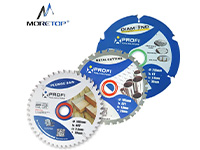
On Moretop’s site, product examples such as the demo and framing circular saw blade and the rebar metal cutting blade show the kind of application segmentation distributors should expect from a supplier conversation.
Audit manufacturing scale and process control
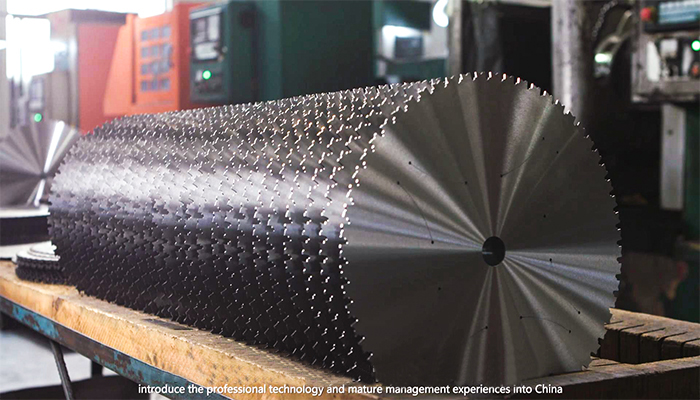
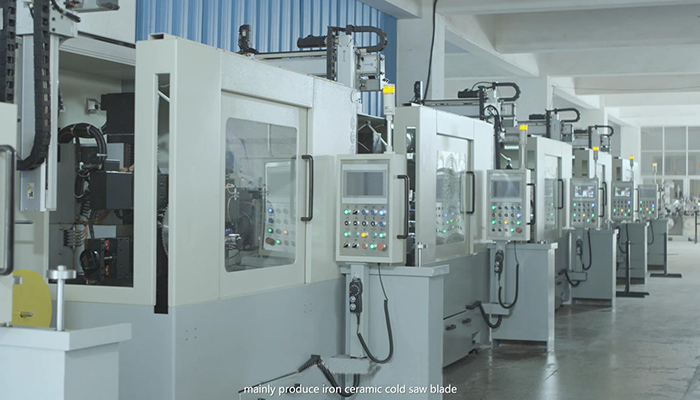
Capacity matters, but process discipline matters more. Buyers should ask how blade blanks are prepared, how tensioning is controlled, how carbide tips are attached, how grinding is checked, and how finished blades are inspected before packing. The point is not to force a factory audit from day one. The point is to see whether the manufacturer has a real process language and can explain it clearly.
According to Moretop’s current site information, the company presents more than 20 years of OEM and ODM experience in power tool accessories and annual cutting-blade capacity in the millions, alongside a large working area and a broad manufacturing network. Those are useful starting signals, but distributors should still translate claims like these into practical questions about batch size, bottlenecks, and replenishment stability.
Ask how quality is verified batch by batch
Distributors should avoid vague phrases like “good quality” and request batch-level verification points instead. For saw blades, practical quality conversations usually include plate flatness, balance, brazing integrity, tooth sharpness, run stability, cut cleanliness, and consistency across repeat orders.
- Ask what incoming material checks are performed on steel and carbide.
- Request sample-cut evidence on the materials you actually sell into.
- Confirm whether pilot samples and production samples are reviewed separately.
- Ask how non-conforming batches are isolated and traced.
- Check whether packaging protects blades from transit damage and tooth impact.
If a supplier cannot explain these controls, the distributor is effectively paying to become the test lab.
Compare OEM and private-label support beyond logo printing
Private-label programs succeed when the supplier supports the commercial layer as well as the product layer. That includes packaging structure, label compliance, claims hierarchy, carton logic, photo support, and sometimes video or marketing assets. Buyers who only ask “Can you print my logo?” miss the harder part of private label: making the range understandable and credible in the target market.
Moretop’s current positioning highlights package design, logo creation, videos, and brand guidance alongside product supply. For distributors and importers, that is a meaningful differentiator because it reduces coordination across too many vendors and helps new ranges launch faster.

Pressure-test MOQ, lead time, and replenishment logic
MOQ is not only a purchasing issue. It is also a range-planning issue. A supplier may offer a competitive unit price while forcing too much inventory into the first order. That can damage cash flow and slow range rotation. Ask how the factory handles starter orders, mixed loads, repeat orders, and urgent replenishment.
Moretop’s current product-page claims mention response within 24 hours and mass-production windows around 40 to 50 days, with some items also showing low-MOQ positioning. Those are useful benchmarks for a distributor discussion, but the real test is whether the supplier can apply them to your exact assortment, packaging, and reorder cycle.
- Request separate lead times for stock-supported items, sample orders, and fresh production.
- Ask which SKUs can share a mixed order without harming delivery reliability.
- Confirm whether replacement blades, inserts, labels, and cartons can be reissued quickly.
- Check whether the supplier can support small launch volumes and larger repeat volumes without re-engineering the range.
Evaluate communication speed and technical support
Slow communication creates hidden cost. It delays quotation rounds, extends sampling, slows artwork correction, and makes urgent replenishment harder to manage. Distributors should test responsiveness before the first order by sending a structured request and measuring how the supplier replies. Fast replies alone are not enough. The answer must also be technically specific.
A good supplier response should identify missing inputs, recommend a more suitable blade when necessary, flag performance risks, and summarize the next step in plain language. This is especially important when distributors sell through dealers who need quick answers on application suitability.
Confirm commercial terms and documents early
Commercial friction is easier to fix before sampling than after artwork approval. Confirm payment terms, carton labeling rules, barcode requirements, master-pack logic, claim handling, and document availability at the quoting stage. If the range is going to retail or e-commerce, discuss packaging tests, warning language, and image specifications at the same time.
Professional suppliers welcome this level of clarity because it shortens the path from inquiry to shipment. It also reduces the chance that sales, purchasing, and design teams are working from different assumptions.
Use a distributor scorecard before placing the first bulk order
One of the cleanest ways to compare Chinese saw blade manufacturers is to use a simple scorecard. That forces the team to compare suppliers on actual business risk rather than on the FOB price alone.
Distributors that score suppliers this way usually make better long-term decisions, even if the chosen partner is not the cheapest on the first quote.
Why Moretop belongs on a practical shortlist
Moretop fits a practical shortlist for distributors that want a category-focused Chinese partner rather than a generic trading catalog. The company’s current site positions it around cutting and drilling accessories, OEM and ODM support, packaging and branding help, and service for importers, regional wholesalers, distributors, retailers, and e-commerce sellers. It also highlights a 24-hour response target, broad manufacturing support, and product development resources including overseas R&D and distribution support.
That does not mean a distributor should skip normal due diligence. It means Moretop is presented in the way serious buyers usually want to evaluate a supplier: by category focus, commercialization support, and operating discipline, not just by list price.
FAQ: Questions distributors ask before approving a saw blade supplier
Should I choose the factory with the lowest quote?
No. The lowest quote often hides the highest downstream cost if the blades create claim issues, require heavy rework, or slow replenishment. Compare total operating value, not only FOB price.
What sample stage matters most?
The most useful stage is a sample set that matches your final application, packaging direction, and target performance claims. A random sample proves very little.
How many blade families should a new distributor launch with?
Start with a tight core range that covers the most common materials and buyer profiles in your market. Expand after reorder data shows which applications deserve more depth.
Closing summary
The right saw blade manufacturer in China is the one that helps a distributor build a reliable range, not simply place a low opening order. Start with application fit, verify category depth, test quality discipline, review OEM support, and score communication and replenishment realism. If a supplier can combine those factors with competitive pricing, the distributor has a partner worth scaling.


